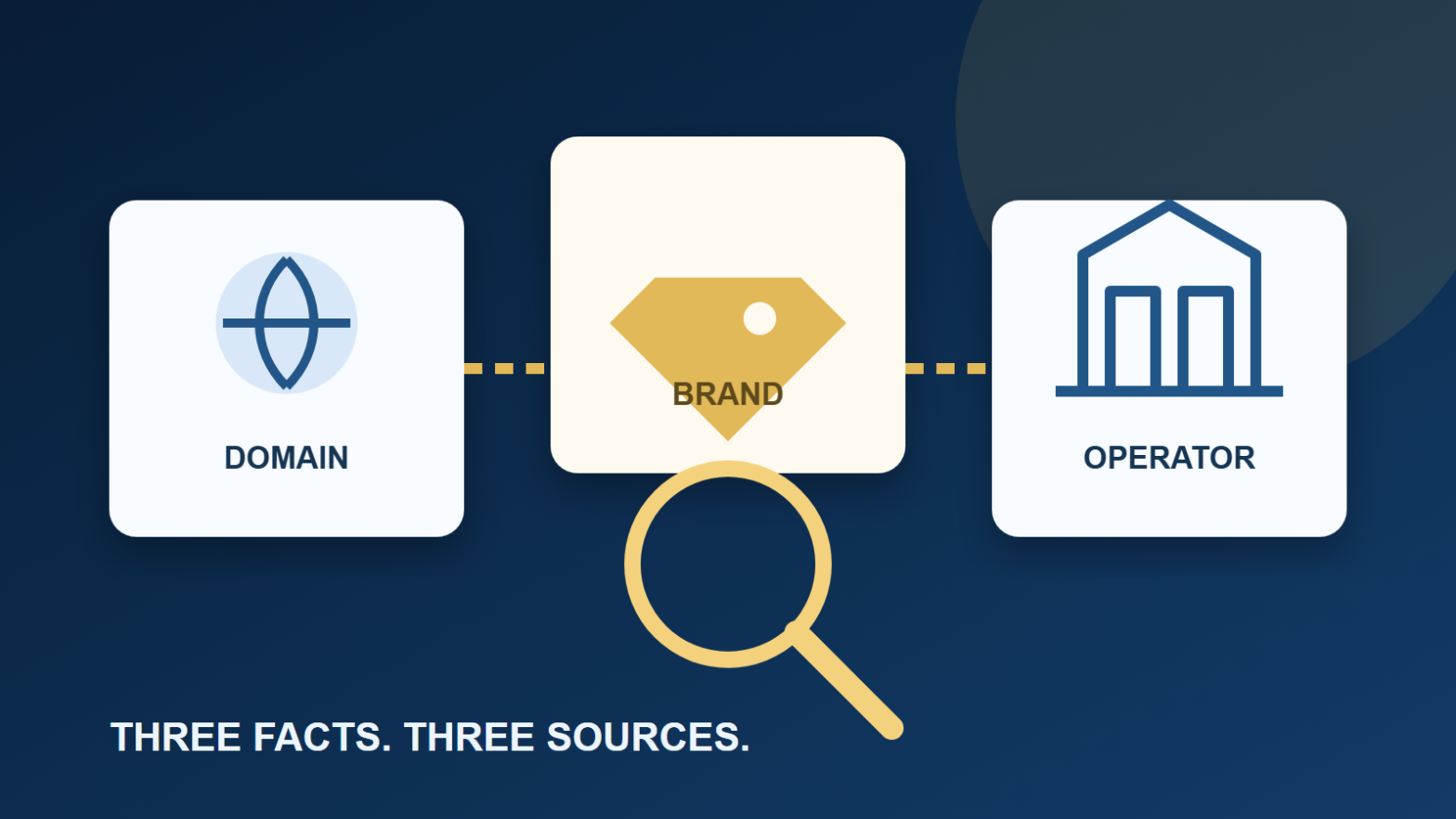
A domain name, a brand label and an operating company can appear together on one website, but they are not the same fact. Treating one as proof of the others is a common source of overconfident casino reviews. A careful check records what each source actually establishes and leaves unsupported relationships unconfirmed.
A domain identifies an internet address
A domain tells a browser where to request a website. Registration data may show a registrar, creation date, nameservers and some registrant information, although privacy services and data-protection rules can limit what is public. ICANN provides a registration data lookup tool for current public records.
That data does not automatically identify the company providing every service shown on the site. A domain can be registered by an agency, held through a privacy service, redirected to another address or used under a licence. A registration date also does not prove when a brand began trading.
A brand is a name presented to customers
A logo or repeated trading name establishes how a website presents itself. It does not, by itself, identify the legal entity behind the service. Similar names can be used in different regions, and a product name can differ from a company name.
Reviewers should quote the brand as a presentation fact: “the site displays the name X.” A stronger statement—such as “X is operated by company Y”—needs a source that directly connects that exact brand or domain with that entity.
An operator claim needs a traceable source
Useful places to look include the website’s terms, privacy notice, footer, company register references and a relevant regulator’s public register. The evidence should match the same domain, legal entity, activity and date. A record for a similarly named company or a different domain cannot fill the gap.
Availability is not authorisation. Being able to open a website in a country does not demonstrate that a particular service is authorised there. Likewise, a licence logo is a claim until the register entry and scope can be checked.
Use an evidence table instead of a single verdict
| Question | Potential source | What it can establish |
|---|---|---|
| Which domain was checked? | Address bar and archived capture | The exact URL reviewed on a stated date |
| Which brand name is displayed? | Homepage, footer and terms | The name presented by the site |
| Which entity claims to operate it? | Terms or privacy notice | The site’s own operator statement |
| Is that relationship independently recorded? | Company or regulatory register | A dated external record within its stated scope |
How ORC handles uncertainty
ORC’s review evidence standards separate direct observation, operator statements and independently checked records. That approach is especially important when ownership information is incomplete. The site’s scam-warning guide also lists practical warning signs, but a warning sign is not a substitute for evidence about one specific company.
If a relationship cannot be confirmed, the accurate wording is “not verified from the sources checked,” not “false” and not “safe.” Recording the check date allows a later reviewer to see whether the site or register changed.
Commercial reference disclosure
WABO222 and AB33 are customer-requested external commercial references. They are not used as evidence for the framework above. This article makes no finding about their legal entities, licences, ownership, availability or safety.
A reliable review does not force three different facts into one label. It records the domain checked, the brand displayed, the entity claimed and the independent evidence available for that relationship.